



Short Summary
Many researchers search PubMed to find articles on a topic, but few know how to visually map related research and identify gaps. In this post, I explore a real example using my paper on searching PubMed in radiology — and demonstrate how a tool like Connected Papers can help researchers refine or choose a research topic by finding related research or identifying research gaps or both!
Why This Topic Matters
When we publish, we often wonder: Who else has written something similar? Has the topic evolved? Is there a gap I can explore further?
Traditional searching gives us a list of results — but not the relationships between them. How do we find related research?
This is where Connected Papers becomes useful.
What is Connected Papers?
Connected Papers allows you to enter one research article and generate a visual network of related papers — not just by direct citation, but by similarity of references and themes.
It shows:
- A visual “cluster” of related work
- Papers that came earlier (Prior Works)
- Papers that came later (Derivative Works)
- How dense — or sparse — the research around a topic is
This makes it easier to explore the development of a topic and identify gaps. And automatically figure out if there are related research papers or if we can figure out research gaps
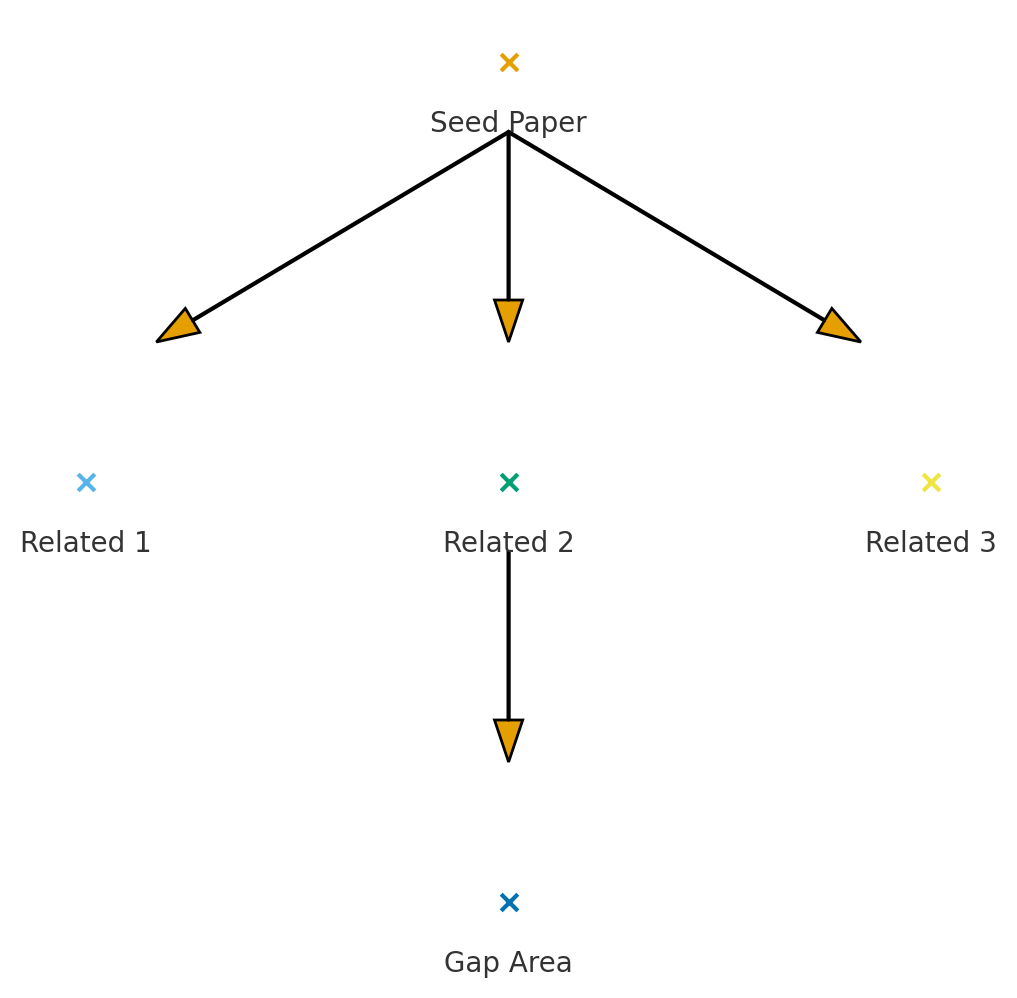
A Real Example: Radiology and PubMed Searching
I tried this tool starting with one of my own publications:
➡️ Using PubMed in Radiology: Ten Useful Tips for Radiologists – PMID: 22013289
Through PubMed searching, I found many papers on literature searching in general — and many about using PubMed — but almost none specific to Radiology, and especially not a structured “tips” approach.
When I ran the same paper through Connected Papers, the visual cluster confirmed this gap:
- A large group of papers exists on literature searching
- A separate cluster exists on radiology informatics
- But there is almost no direct cluster connecting Radiology + structured PubMed search guidance
That “thin connection” tells a story:
🔍 There is room — even now — for updated, specialty-focused guidance.
Interestingly when an Editorial Board member of the Radiology journal asked me to write this article – I was reluctant, saying that there are enough papers on PubMed searching. If Connected Papers existed then, I would have hesitated less. What made me accept was that PubMed had then had a new interface!
How This Helps in Choosing a Research Topic
You can use the same process:
- Start broad – search PubMed using keywords
- Find a relevant “seed” paper
- Use Connected Papers to explore related work visually
- Look for:
- Dense clusters → well-covered topics
- Sparse clusters → possible research opportunities
This approach helps you move from:
Broad Topic → Narrow Niche → Clear Research Gap
Key Takeaways
In my example, the tool confirmed that Radiology-specific PubMed search guidance remains limited — indicating potential for future work.
Connected Papers – rather than giving us only reading lists, helps you see research relationships by finding related research and by identifying research gaps
It is especially useful when refining a topic or evaluating novelty.
Call to Action
If you’d like to learn how to search more systematically and identify research gaps with confidence, explore our resources at qmedcourses.in or connect with us for training.
#ConnectedPapers #LiteratureSearch #PubMed #ResearchSkills #RadiologyEducation #MedicalResearch #SystematicReview