


Search Skills Matter
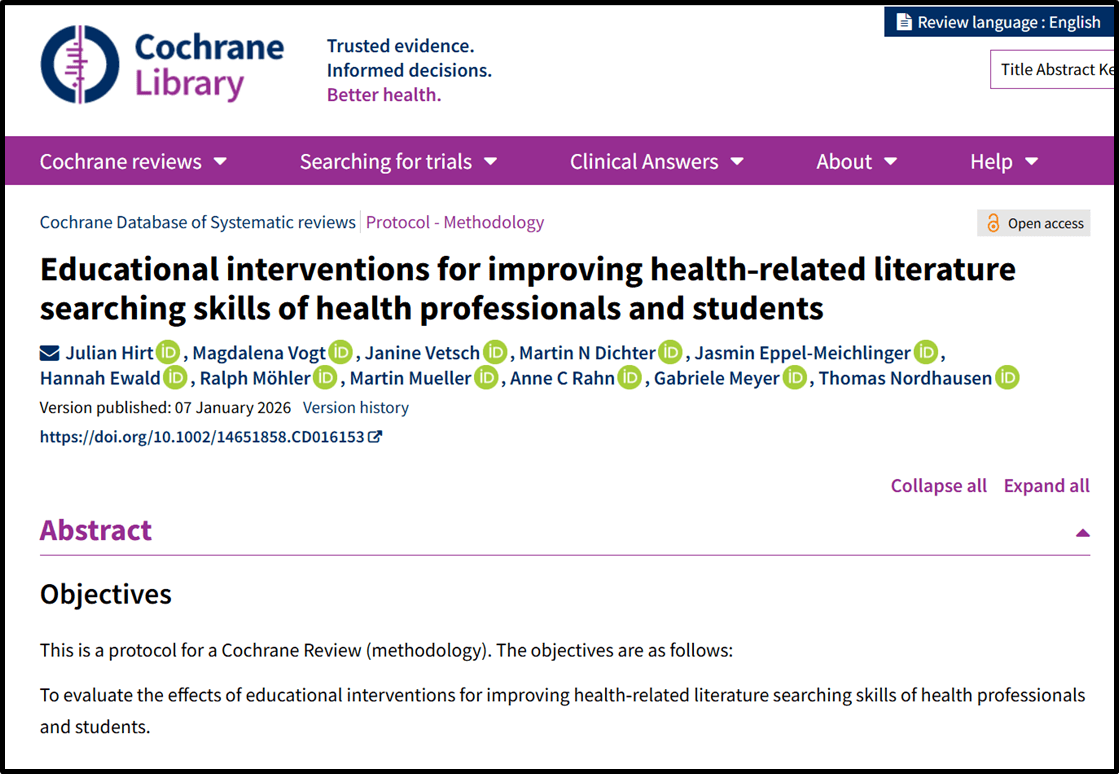
We talk a lot about evidence-based practice, but far less about the skill that makes it possible in the first place: finding the evidence. A newly published Cochrane protocol examining educational interventions for literature searching sends a clear message—searching skills matter, and gaps in training persist across health professions
Not All Searches Are the Same
A key message from the Cochrane protocol is that not all searches serve the same purpose—a distinction often described as precision versus recall, but rarely explained to health professionals.
Searching for precision aims to find a small number of highly relevant papers quickly. This is what clinicians need in practice, when time is limited and decisions about patient care must be made efficiently.
Searching for recall aims to find all relevant studies, even if that means screening many results. This approach is essential for systematic and scoping reviews, where missing key studies can bias conclusions.
Confusing these two approaches leads to poor searches. A precise search is rarely sufficient for evidence synthesis, while a high-recall search is usually impractical for clinical care. Understanding the difference is therefore a core skill for both librarians and health professionals.
Takeaway: Good searching starts with knowing whether you need speed or completeness. For systematic and scoping reviews, searching must prioritise completeness—precision alone is not enough.
Searching Is a Team Skill: Librarians and Health Professionals Together
In India, there is an urgent need to build capacity in medical librarianship with advanced search expertise. This will take time, planning, and sustained investment. Existing librarians need structured upskilling, and new librarians must be prepared to acquire these skills early.
But librarians alone are not the solution. Health professionals themselves must understand searching skills—so they know what good searching looks like, what to expect from librarians, and how to communicate and work with them as methodological partners. When both sides share this understanding, the search work can be balanced appropriately and done well.
A Call for Policy and Planning
Top councils and commissions must create clear policy frameworks that mandate training in searching skills, define roles for medical librarians, and guide institutions on how to recruit and integrate this expertise.
Because evidence doesn’t start with results. It starts with the search.
Article citation:
Hirt J, et al. Educational interventions for improving health-related literature searching skills of health professionals and students. Cochrane Database Syst Rev. 2026 Jan 7;1(1):CD016153. doi: 10.1002/14651858.CD016153. PMID: 41498627; PMCID: PMC12777918.
SearchSkills #EvidenceBasedPractice #SystematicReviews #Cochrane #HealthProfessionals #MedicalLibrarians #EvidenceSynthesis #HealthResearch #InformationLiteracy